
T100 Vancouver 2025: The Canyon Speedmax CF 7 Di2 Debut, a Brutal Run, and Getting My Medal from Paula and Eric
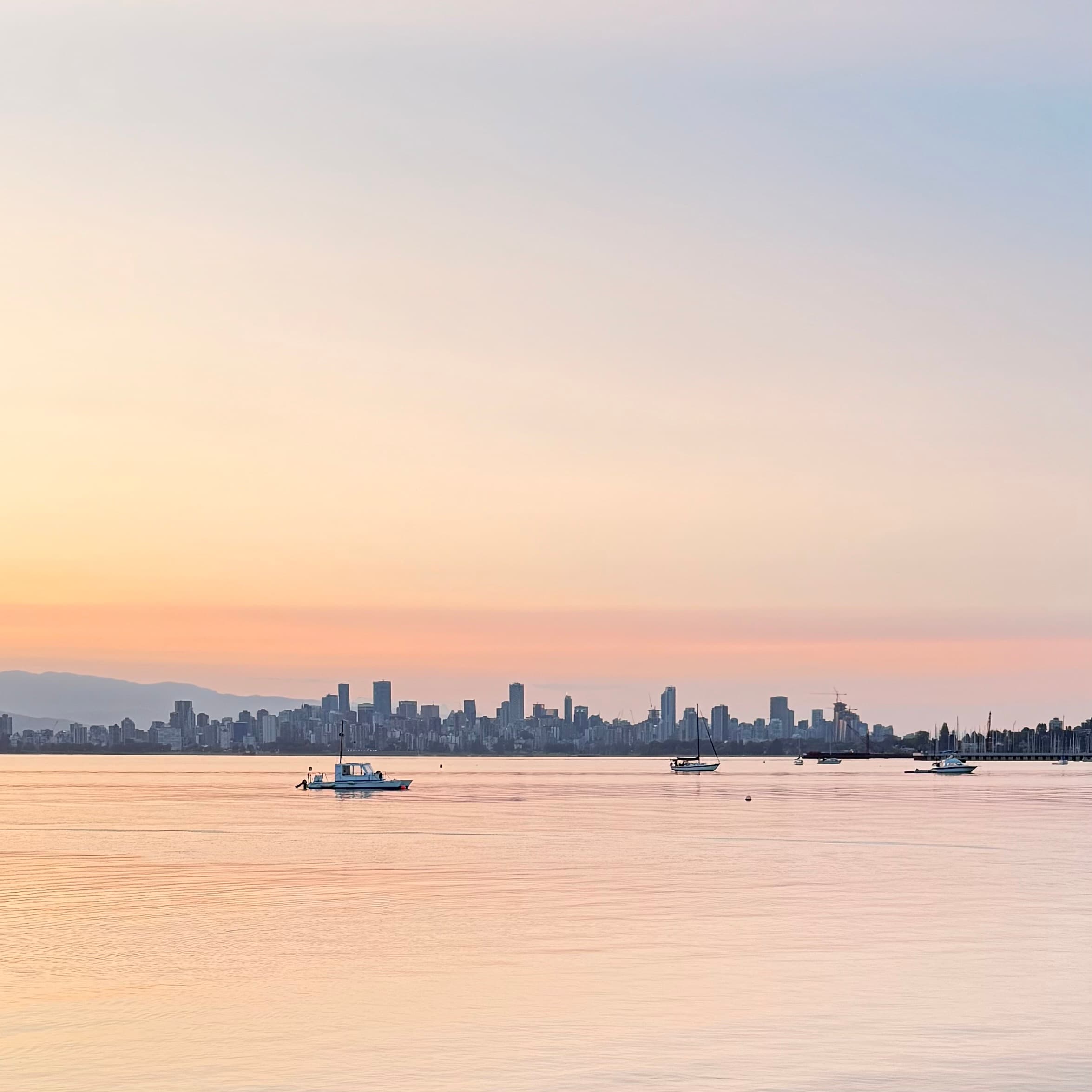
Almost a year after my first 70.3 in Victoria — cold, grey, scared of the disc wheel — I lined up for the T100 Triathlon in Vancouver on a Sunday morning that looked nothing like that. Warm water, glassy English Bay, a pink sunrise over the city skyline. First race on my new Canyon Speedmax CF 7 Di2. And at the finish line: two of the athletes who made me fall in love with this sport.
Coming back
The T100 Triathlon is a professional middle-distance race — 2km swim, 80km bike, 18km run — part of the PTO's T100 World Tour. The pros had raced in Vancouver the day before. Age groupers got Sunday, and we got the better end of the deal. The water was warm and calm. The air was still. We were much luckier than the pros.
This was my first race since Victoria 70.3 in May 2024. Nearly a year away from the start line, which felt like a long time. The goal at Victoria had been to survive and finish — which I did, but not without a bike leg I'm still learning from. Too much wheel for the conditions, too much fear, never got into the aerobars. If you want to see how that race unfolded, read my Victoria 70.3 2024 race report. Coming into Vancouver I wanted to race with some actual confidence.
I also had new equipment. The Canyon Speedmax CF 7 Di2 replaced the Cervelo. Getting comfortable in the aero position — really getting there, not just surviving — was the thing I'd worked on the most since Victoria. This race was going to be the first test.
The TTL kit
I raced in a TTL kit — That Triathlon Life, the brand built by Eric Lagerstrom and Paula Findlay. I'm going to be upfront about what that kit means to me: these are two of the athletes who are directly responsible for why I got serious about this sport. Their content, their honesty about the hard parts of training, the way they made triathlon feel accessible without dumbing it down — that got me here.
Wearing that kit to a T100 race, in Vancouver — Paula's home country — was intentional. I had no idea at that point what would happen at the finish line.
Race morning: 3am, Thunderbird parkade, glassy water
Left home at 3:00am. Got to Thunderbird parkade at 3:30, on-site by 4:00. Set up nutrition on the bike, programmed a 20-minute gel timer on the bike computer, hit the porta-potty (mercifully clean at that hour). By 4:30 I was in kit, jogging a little, getting my head in order.
Got in the water at 5:05 for a warm-up swim, out by 5:15. The water was genuinely warm. After the shock of Victoria, I'd forgotten what it felt like to get into open water and just feel relaxed. This was that.
The week leading in had been stressful — I wasn't sleeping well, wasn't eating as clean as I should have, and the familiar pre-race anxiety showed up right on schedule. Therapy on Wednesday helped. By the time I was standing at the start, I'd made a conscious decision to race for myself, not to prove anything. That shift made the whole morning easier.
Swim: warm water, good rhythm, one small surprise
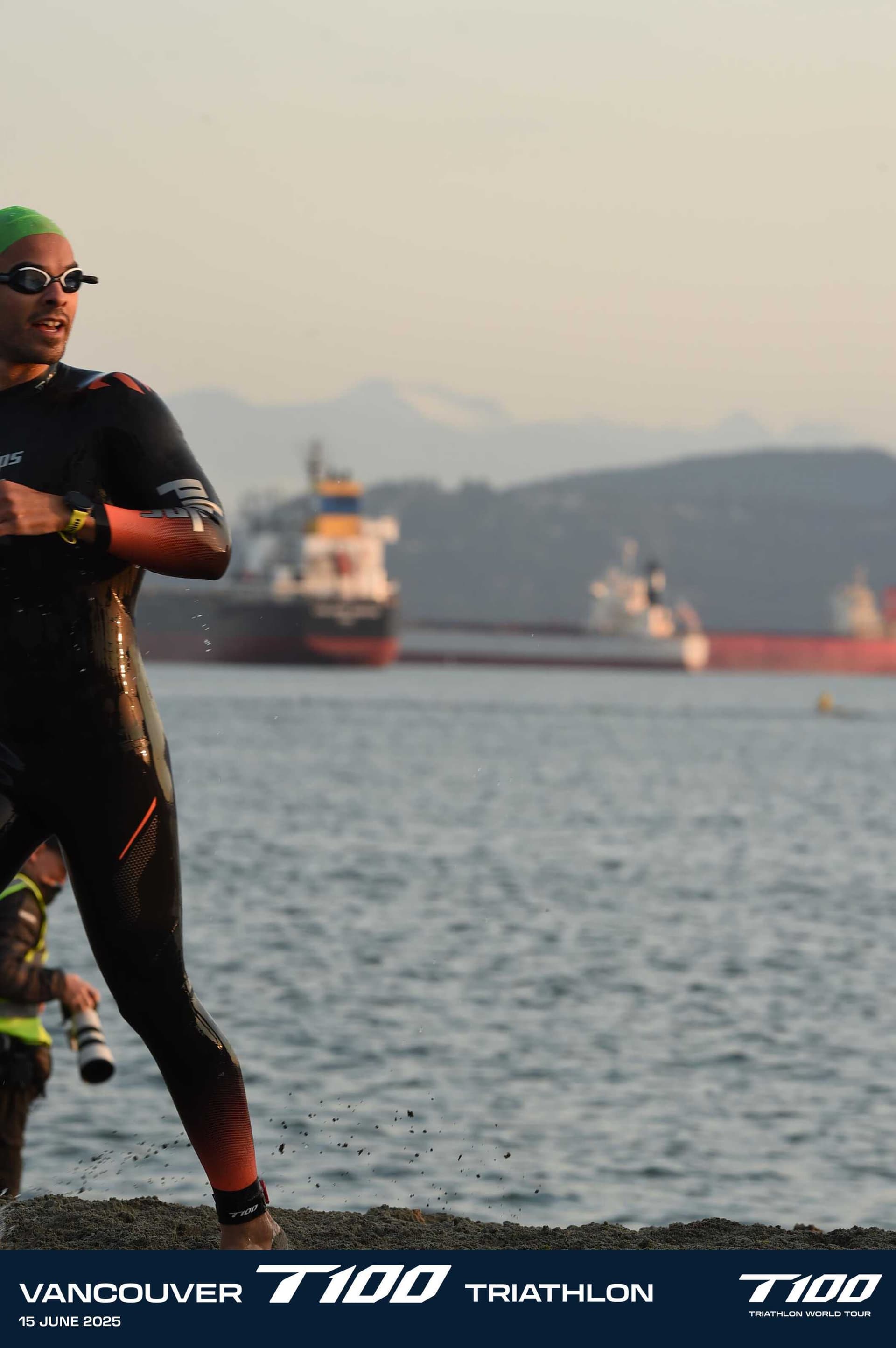
Rolling in after about 10 minutes. The moment I started moving I found a rhythm — something that didn't happen in Victoria until it was almost over. The water was calm enough that sighting every 4–6 strokes was easy. I wasn't fighting conditions or my own anxiety. I was just swimming.
Most people around me were going slower, so drafting wasn't much of a factor. I pushed my own pace. Near the end of the second lap I started to feel some abdominal cramping — enough to notice, not enough to panic. I came out of the water feeling strong, ran toward transition, and started dealing with the cramps there.
T1: cramps, cycling shoes, adrenaline
Transition was mostly smooth — wetsuit off, cycling glasses on, helmet on, gels tucked into the kit. The cramps made getting down to clip my cycling shoes harder than it should have been. I was scared the calves were going to go. They didn't. I got out onto the bike.
Bike: the Canyon Speedmax CF 7 Di2, full send, and some regret
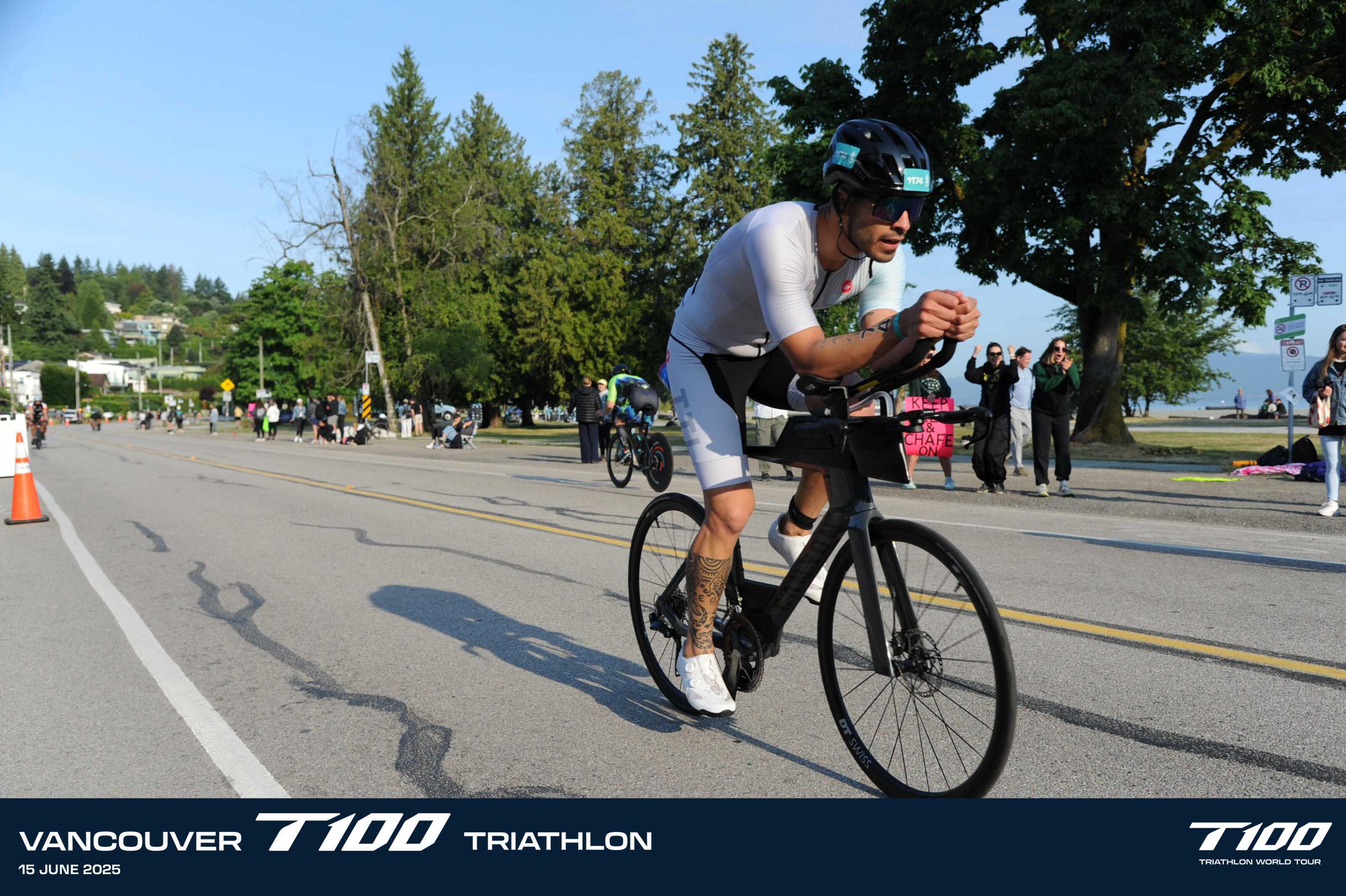
This was the Canyon Speedmax CF 7 Di2's race debut. And I'll say this: getting on that bike felt completely different to Victoria. I got into the aerobars almost immediately. Held them for most of the ride. The confidence I'd been building since last year was actually there when I needed it.
The plan was 215w on the flats, 230–250w on the climbs. I stuck to it. I was also hitting 120g of carbohydrate per hour — a 40g SIS gel every 20 minutes, timed by the alarm on my bike computer. The nutrition side felt controlled. The legs felt good. The first two laps felt like exactly what I'd trained for.
Somewhere around the start of the final lap I started to register what I'd done. Not a crisis — but a quiet awareness that the run was coming and I'd spent more than I'd budgeted. I kept going at pace. I finished what I started on the bike.
T2: missing the race belt, one shoe on the bike
T2 was rough. I took my right foot out of the shoe on the bike going into transition — but left the left one in, which meant I was hopping in awkwardly. I'd been scared of cramping the whole ride and it made me timid. Socks weren't on right. I forgot my race belt entirely. Just got moving.
Run: 4:20/km out of nowhere, Achilles, and counting to four
I went out hard. Too hard. I didn't look at my watch for the first few kilometres — which had worked fine at Victoria — but here it meant I was running 4:20/km without knowing it, off a bike I'd pushed to the limit. By the time I checked later that evening, I understood why the run felt the way it did.
The Achilles was there from kilometre one. Not sharp, but present — a constant low-grade protest from the start to the finish. I knew before the race it was an issue. I ran through it. That was the decision.
A gel at 30 minutes, another at 60. Water at the aid stations. The stomach was not happy — by the third and final lap, significant abdominal cramps had joined the Achilles in the rotation. I stopped to pee early. I slowed down. I kept going.
My mantra for the run was the simplest thing I could hold onto: one foot in front of the other. Count to four. Repeat. When I was at my worst I just counted steps and refused to think beyond the next four.
Looking back, I think there was also a nutrition issue I didn't fully understand until later: every SIS gel I took on the bike had caffeine in it. At 120g per hour, that's a lot of caffeine over three hours. By the run I was likely running on fumes — and caffeine-overloaded, which probably contributed to the GI issues more than I realised at the time. Next race the gels will be mixed: some with caffeine, most without.
The finish line
I crossed the finish line grateful — for my legs, for the morning, for getting to race at all. I'd trained through an injury-free block and got to the start line healthy. That matters more than the splits.
Then I turned around to get my medal. And there were Paula Findlay and Eric Lagerstrom.
I was wearing their kit. In Paula's home country. At a race that the two of them were helping run as medal presenters. People in the crowd had been shouting for the TTL kit throughout the run — every lap, there were cheers. I'd felt it even when everything else was hard.
Getting that medal from those two specific people, in that specific moment — I don't have a way to explain how much that meant without it sounding excessive. So I'll just say it was the best part of the day, and leave it at that.
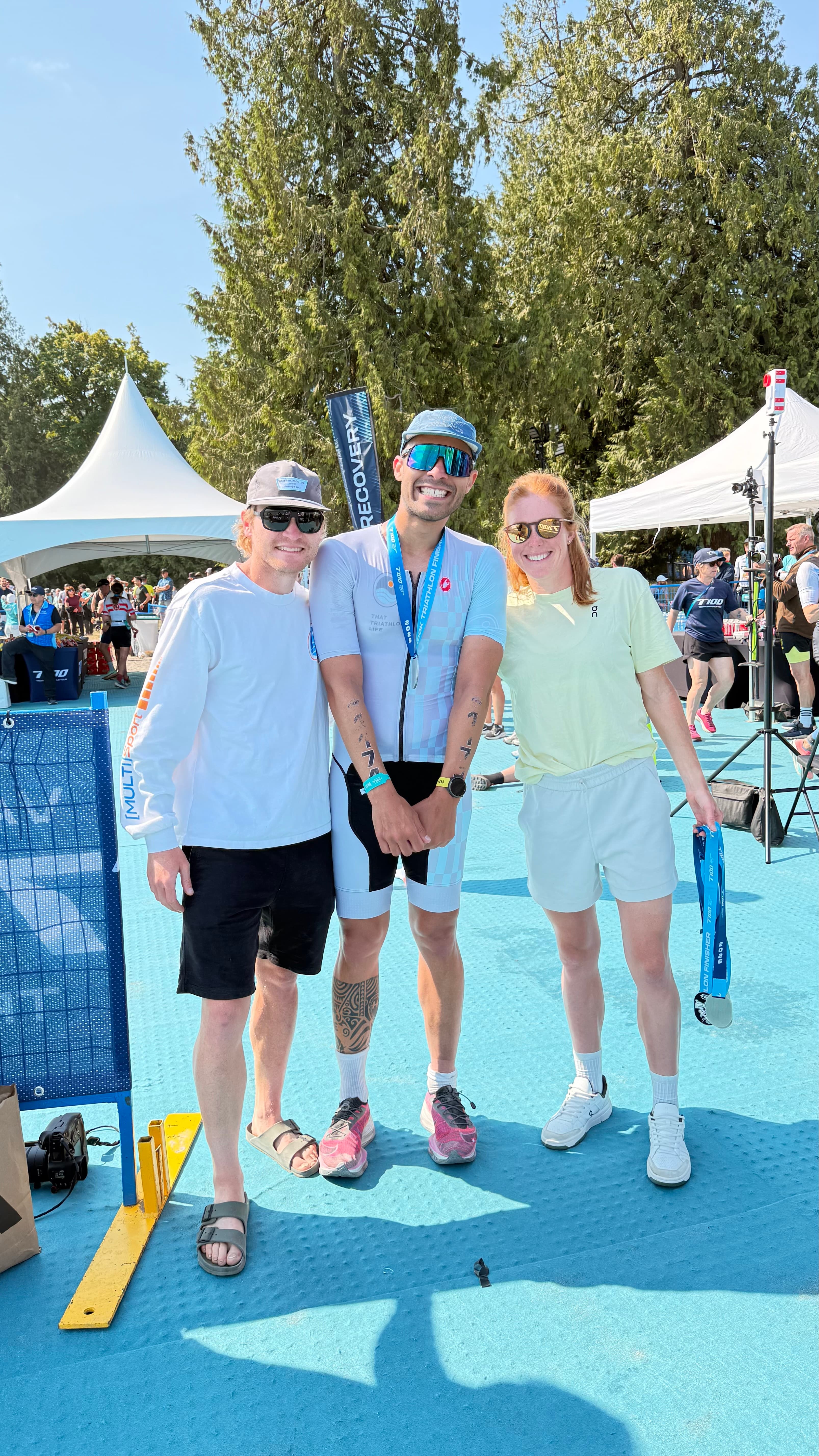
Eric Lagerstrom, me, and Paula Findlay at the T100 Vancouver finish line. Wearing their kit to meet them there felt like a full-circle moment.
What I'm taking from this
- The Canyon Speedmax CF 7 Di2 works. Getting in the aerobars and staying there for a whole bike leg felt like something I couldn't have done a year ago. That confidence is real and I'm building on it.
- Don't use only caffeine gels. 120g/hour is fine. 120g/hour of caffeinated gels for three hours is a problem. Mix it up — save the caffeine for the back half of the bike and the run.
- Check the watch in the first kilometre of the run. Going by feel works well in training. Off a hard bike effort at race intensity, it means running 4:20/km without knowing it. One early check would have saved me.
- Brick workouts. The transition from bike to run is where the wheels came off. More race-pace bricks between now and September.
- The swim is improving. Finding rhythm from the first strokes, sighting cleanly, coming out feeling strong — that's progress. There's still more in the tank there technically, but the direction is right.
The next target is a 70.3 in September. Better aerobars work. Better nutrition execution. More bricks. A smarter run start. The building blocks are there — Vancouver showed me that. Now it's about putting them together cleanly.
Thinking about your next race?
Use the estimator to see how your expected splits compare to the historical field at your target race — or browse qualifying benchmarks across the global 70.3 calendar.
Try the race estimator