
Am I Actually Making Progress? How to Tell When Your Training Is Working
Almost every athlete I know has sat with the same quiet worry: am I actually getting better, or am I just spinning my wheels? We pour months into a sport that gives back its verdict once or twice a year, on race day — and in between, we're left staring at data, trying to read the future in a heart-rate graph. Here's what I've learned about assessing progress honestly, and how to stop the number-chasing from stealing the joy out of training.
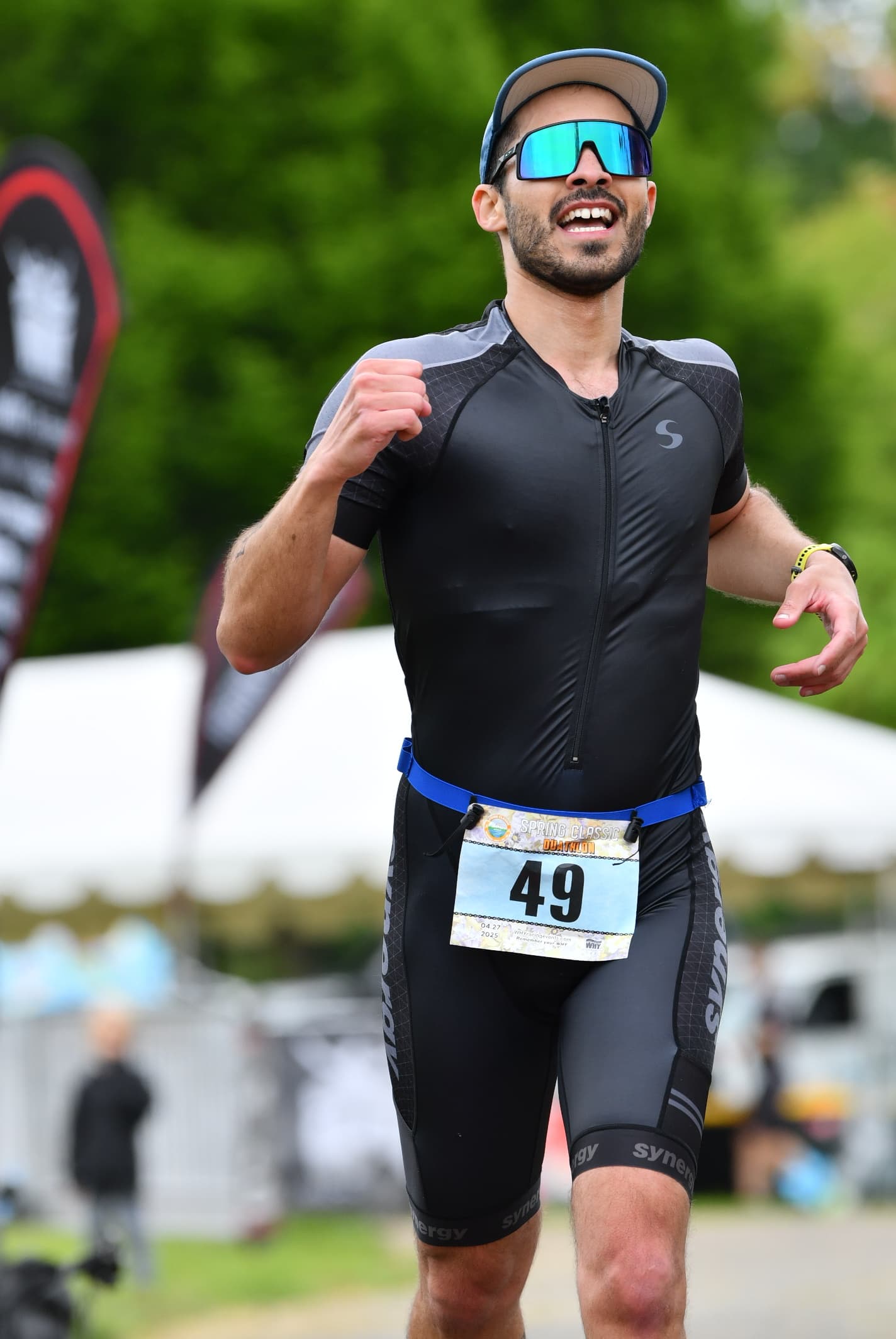
Finishing the Spring Classic Duathlon, April 2025.
The overthinking spiral
It is so easy to get caught up in our own heads. We scroll back through old race results and pick at them like scabs. We open the training app and hunt for nuance in our heart rate and power — a couple of watts here, a few beats there — searching for a sign, any sign, that fitness is trending in the right direction. We compare this block to the last one. We compare ourselves to a training partner who seems to be flying, or to a rival in our age group whose Strava suggests they never take a day off. And, of course, we obsess over the number on the scale, convinced that a kilogram is standing between us and the athlete we want to be — a rabbit hole I've written about at length in Weight Management for Triathletes.
None of this is irrational. Wanting to improve is why we do this. But there is a point where analysis stops informing your training and starts eroding your confidence in it — where you've zoomed in so far on a single week that you've lost sight of the two-year arc that actually matters. Endurance sport is one of the slowest feedback loops in athletics. Read too much into any single data point and you'll drive yourself quietly crazy.
Consistency beats methodology — almost every time
If I could tattoo one idea onto the inside of every anxious triathlete's wrist, it would be this: the single most important variable in endurance training is consistency. Not your interval structure, not your zone distribution, not which guru's plan you're running. Showing up, week after week, month after month, year after year, will out-perform almost any specific methodology you could obsess over in the meantime.
That doesn't mean methodology is worthless — it means it works on top of a base of consistency, not instead of it. Plenty of respected coaches make exactly this case for varying your stimulus over the long haul: following a periodised, block-based approach for a year or two, then shifting toward a more threshold-focused build the year after. It's the same reason so many athletes — amateur and professional alike — deliberately change coaches or plans periodically: not because the last one failed, but because a new kind of stimulus knocks them out of an adaptation rut. The through-line underneath all of it is that they kept training consistently the whole time.
It also helps to remember that progress is not linear. As Scientific Triathlon and USA Triathlon both point out, the big-picture trajectory should trend up, but it will always contain dips — and the planned dips are the recovery that lets you reach a higher baseline in the next block. A flat stretch on the graph is not always a plateau. Sometimes it's just the part of the story right before the next step up.

Racing back in 2022 — years before I'd ever heard of an FTP test or an efficiency factor.
My own frustration: the running PB I can't beat
I struggle with all of this too — especially with my running. I was a runner first. I started in 2019, and until 2023, before I took triathlon seriously, I trained like one: I followed Pete Pfitzinger and Philip Latter's Faster Road Racing: 5K to Half Marathon almost to the letter. In some blocks I was stacking 70 km weeks, and it showed — I felt sharp, light, and genuinely fast off the line. By 2023 I'd run my 10 km personal best.
Here's the part that eats at me: I haven't beaten that 10 km PB since. Three years later, running consistently the whole time and pouring enormous aerobic volume into triathlon, and the number won't budge. So what's the reason? Is it the split attention across three sports? Is it a lack of time spent at the right intensity — all those easy aerobic kilometres crowding out the sharp, race-specific work? Is it not having a dedicated human coach for the run? Or is it something less comfortable to admit: that I made so much progress so quickly in my first few years that I got used to improvement, when the truth is that getting faster only gets harder the fitter you already are?
I genuinely don't have a tidy answer, and I think that's the honest place most of us actually live. The early years of any sport are a firehose of newbie gains. The years after are a slow negotiation. Mistaking the second phase for failure — just because it doesn't feel like the first — is one of the most common ways athletes talk themselves into quitting something that's still working.
The race that reframed everything
Then came a data point I couldn't argue with. Last year at Ironman 70.3 Washington Tri-Cities I had a breakthrough. I put together a genuinely solid day across all three disciplines — a good swim, a strong bike, and then I came off that bike and ran a 1:40:00 half marathon. If you've never done it, running a sub-1:40 half on already-hammered legs is no small feat.
And it clicked. My open 10 km PB might be stuck, but that's the wrong scoreboard for the athlete I've become. My training is working — it's just building a different engine than the one that set that PB. It's building the durable, fatigue-resistant endurance that lets me run a fast half off a hard bike. I was so busy measuring myself against my old self that I nearly missed the fact that I'd become a completely different, and arguably better, athlete.
Better questions than "am I improving?"
If the constant self-audit is the trap, what's the alternative? Over the years I've landed on a handful of reframes that keep me sane and, not coincidentally, keep me training well.
1. Trust the process — and let yourself enjoy it
This sounds like a fridge magnet, but it's load-bearing. A consistent training regimen, repeated over time, will beat a "perfect" methodology executed anxiously and abandoned every eight weeks. If you believe that — really believe it — then the day-to-day pressure to prove your progress evaporates. You did the session. You did it again. That is the progress. The fitness is a lagging indicator of a lot of unglamorous, repeated days.
2. Control the controllables
Do the best possible version of everything that is actually within your power, and make peace with everything that isn't. You cannot control whether it rains on race day, or whether a headwind on the back half of the bike course costs you five kilometres an hour you'll never get back. You can control your nutrition, your sleep, your consistency, and your motivation between now and the start line. Pour your energy into that column of the ledger. It's the only one that responds to effort.
3. The best indicator of performance is performance itself
Heart rate, power, and pace are useful proxies, but they are proxies. The truest measure of your fitness is what you can actually do when it counts. So trust your coach, trust your plan, and give race day everything you have — then use the result as information. Ask the honest question: was this performance, good or bad, a fair reflection of my training? Or did I leave something on the table I could have controlled?
My T100 Vancouver race last year is a perfect example of the second kind. I over-biked, plain and simple, and my legs handed me the bill on the run. It also didn't help that I'd quietly skipped every single brick workout in my My Pro Coach training plan. That result wasn't a verdict on my fitness — it was a verdict on two specific, fixable decisions. Reading it correctly was worth more than any amount of staring at the power file afterward.
4. Zoom out, and let the data serve you instead of the reverse
Data isn't the enemy here — the wrong time horizon is. Used well, a few objective checkpoints will tell you far more than daily graph-watching ever could:
- Benchmark tests. A repeatable, tightly-controlled effort — an FTP test, a swim time trial, a 5 km run test — gives you a clean number you can compare across months. USA Triathlon recommends exactly this for diagnosing whether you're truly plateaued or just in a normal trough.
- Standardized workouts. Run the same key session — same course or treadmill, same time of day, same fuelling — roughly once a month and watch the trend. Progress that hides inside noisy day-to-day training often shows up clearly here.
- Efficiency factor. The relationship between your heart rate and your pace or power (TrainingPeaks calls it Efficiency Factor) is one of the cleanest signals of aerobic progress. If you're holding more pace at the same heart rate than you were three months ago, your engine is growing — even if your PBs haven't caught up yet.
- Subjective markers. Sleep, mood, motivation, and how sessionsfeel are real data too. A stack of workouts that feel controlled and strong is a better sign than any single lucky test result.
The trick is that you check these on a monthly or quarterly cadence — not by refreshing the app every night looking for reassurance.
The honest bottom line
You are almost certainly making more progress than your anxious inner monitor is willing to give you credit for. The gains just stopped being loud. They moved from the obvious place — a tumbling PB — to quieter, deeper places: a half marathon you can hold together off a brutal bike, a heart rate that drifts less, a body that absorbs a big week and comes back for more.
So trust the process, control what you can control, race hard, and read your results like an honest coach rather than an anxious critic. Then get up and do the next consistent, unglamorous week. That week is the whole game. Everything else is just trying to read the future in a graph — and the future doesn't live there. It lives in the start line you haven't reached yet.
Stop guessing whether you're on track. Race against real data.
See the finish times, splits, and Top-5% benchmarks for your next race — so "am I making progress?" becomes a question you can answer with numbers, not anxiety. If a 70.3 Worlds slot is the goal, our qualification guide shows you exactly what your training needs to build toward.
Try the race estimatorSources & Further Reading
- USA Triathlon — How to Overcome Plateaus
- Scientific Triathlon — Block Periodisation in Triathlon (EP#68)
- TrainingPeaks — Monitoring Your Triathlon Training Progress (Efficiency Factor)
- Triathlete — The Dreaded Performance Plateau Could Be the First Sign of Something More
- Pfitzinger & Latter — Faster Road Racing: 5K to Half Marathon