Victoria 70.3 2024: My First Half-Distance Triathlon
Cold water, foggy goggles, a wind gust that nearly knocked me off my bike, and a run that saved the whole day. Here's what actually happened at my first Ironman 70.3 — the good, the bad, and the "why didn't I fix my goggles sooner."
The week before: more anxiety than preparation
I'll be honest about the week leading into this race: it was a lot. The excitement of a first half-distance was there, but so was a low-grade anxiety that wouldn't leave me alone. Most of it wasn't about the race itself — it was logistics. Would the bike be set up right? Would the disc wheel be too much? Would the shifters work? I had the bike serviced at a shop in Richmond, got new Continental 5000 tires put on, and even had the broken 3T top cap replaced at the race venue. I was trying to eliminate every possible unknown before race day.
Sleep that week was all over the place. Monday was rough. Tuesday a little better. On Wednesday I spoke with my therapist, and she gave me breathing techniques that actually helped — I slept fine the nights that followed. The exception was the night before the race itself. Nerves took over completely, and I didn't sleep at all going from Saturday into Sunday.
Nutrition was the one thing I managed well that week. Pasta, pizza, carbs across Friday and Saturday, even some real Coke — unusual for me, but race week is race week. I loaded up and trusted the process.
Race morning: 2am, oatmeal, and an Uber in the dark
I was up at 2am. Had oatmeal and banana — a significant amount, three cups, more than I normally eat — plus a coffee. Everything was already packed in my 70.3 bag the night before: wetsuit, goggles, glasses, bike computer, bike shoes, run shoes. It was remarkably calm, actually. The preparation the night before was one of the best decisions I made all week.
Kamylla came with me. We took an Uber at 3:20am, and I got dropped at the race venue at 3:50 — probably an hour earlier than needed. We stood there in the dark, waiting. Time passed faster than I expected, but in retrospect I could have slept a bit more and left later. If I do this again, I'd take an Uber rather than deal with parking and shuttles, but I'd book it a full hour later.
Swim: foggy goggles and a lesson I learned too late
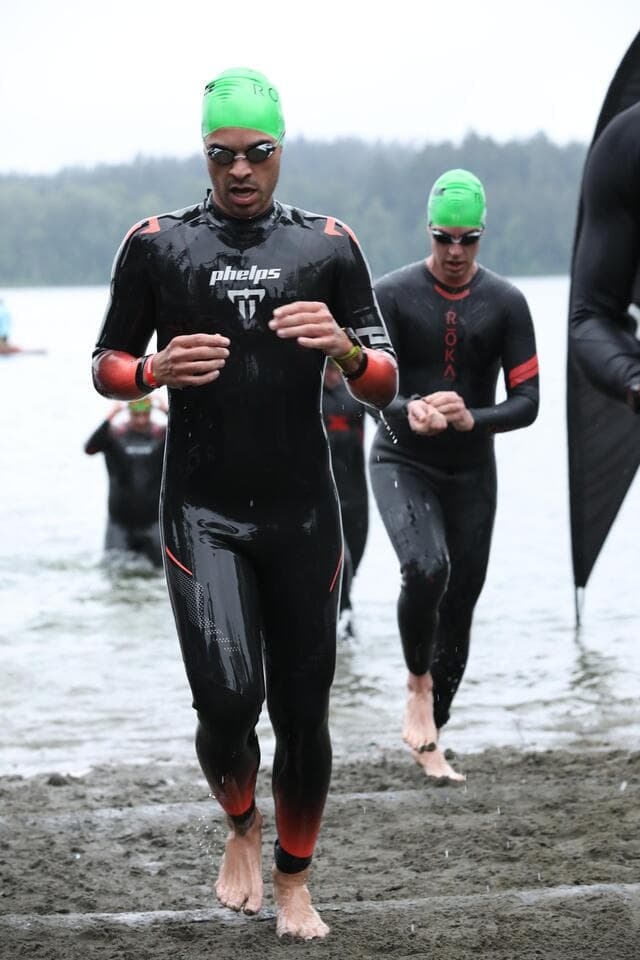
Rolling start, which meant I spent about 20 minutes waiting to get into the water. Standing there, I was already cold and anxious. The combination of cold, nerves, and anticipation made it hard to breathe evenly — I couldn't stay calm before even hitting the water.
When I finally got in, the water was cold enough that my body went stiff and my head was freezing. And then the goggles. I was wearing my Speedo Vanquisher 2.0s — black lenses, which turned out to be the wrong call for that kind of flat, overcast light. They fogged almost immediately.
For longer than I should have, I just kept going. I couldn't see properly, my sighting was a mess, and I was lifting my head every few strokes just to try to find a buoy. I never found a rhythm. I was drafting off feet when I could find them, which helped — but I was mainly just trying to get through it.
The fix was simple and I knew it: stop for five seconds and clear the goggles. I didn't do it until far too late in the swim. That decision — or the failure to make it — probably cost me several minutes and a lot of mental energy. Lesson learned, and filed permanently.
The exit was actually good. I pulled the goggles off, put them on top of my cap, jogged out of the water. That part felt controlled.
T1: the wetsuit fight
Running from the water was fine. Getting the wetsuit off was not. The timing chip was on my left ankle, and the suit got stuck there — it took a frustrating amount of time to wrestle it off. That's something I need to practice: just repeated wetsuit removals until it's automatic.
I also should have had a jacket and transparent glasses ready. In the cold and flat light, my sunglasses were wrong and I was shivering by the time I got on the bike.
Bike: the wind gust that changed everything
I'm going to be straight about this: the bike did not go how I wanted, and most of it was self-inflicted.
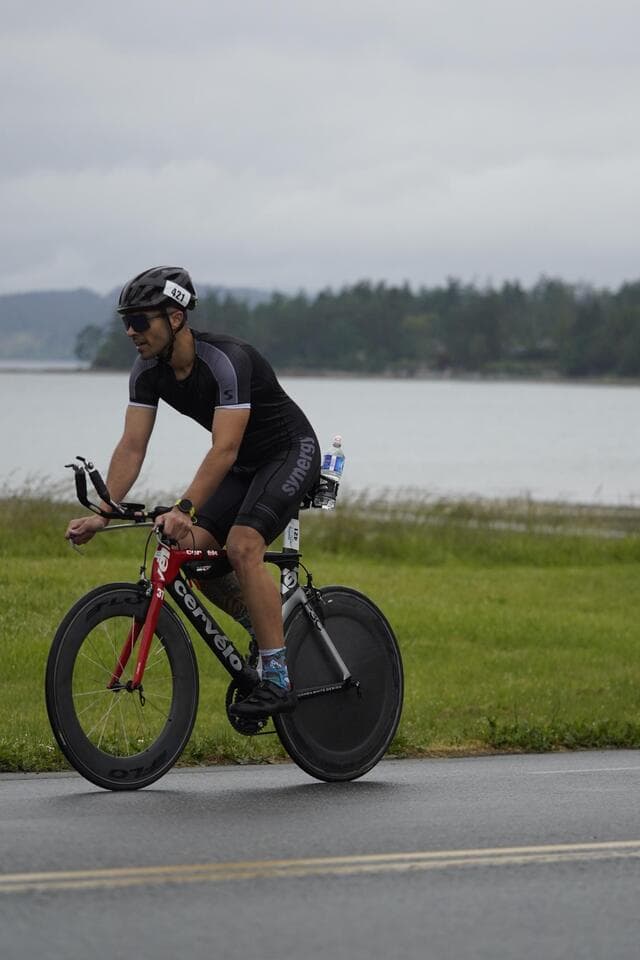
I was running a disc wheel and a 60mm front. In calm conditions on a flat course, that setup can be fast. In Victoria that morning, with random gusts off the coast, it was a mistake. Almost immediately after I started, a strong gust caught my front wheel and I swayed badly. I didn't fall, but it was close enough that something clicked in my head — a fear switch that stayed on for the rest of the first half of the ride.
I couldn't get into the aerobars. I was upright, braking on the descents, cautious on the flats, shaking from cold. My body was tight, my mouth was chattering, and thinking about pace came much later in the race. I was never close to my Z2 power target for the first 45–50 kilometres.
Nutrition was a mixed story. The plan was 90 grams of carbs per hour. I hit that in the first hour — a water bottle plus two gels — but after that, retrieving nutrition from the back of my seat became difficult. I was too scared to reach back with any confidence. I also had to pee three times on the bike, which tells you I over-drank in the lead-up to the race. It was cold, I wasn't working hard, and the water intake didn't go anywhere.
The course itself was genuinely great. Hilly enough to be interesting, with some long descents I would have loved to open up on. I didn't. I braked through most of them. But around the halfway point, I finally started to warm up, find a little confidence, and pick up my pace. The second half was a different ride entirely — more aggressive, more like what I'd trained for.
What excites me about the bike leg is exactly that: the result should have been much better, and I know it. The fitness was there. The execution wasn't. That's something I can fix.
T2: nearly fell twice
My whole body was still shaking when I got off the bike. I almost fell twice in transition — the bike actually hit me on the way down. Getting my run shoes on while that shaky was genuinely hard; I had to sit down to do it, which cost time. I had wet socks I didn't change, had to use the washroom, and just tried to gather myself as fast as I could.
Practicing T2 — specifically putting on race shoes quickly after a bike effort — is going on the training plan immediately.
Run: the legs that saved the day
I did not expect the run to go like it did.
My legs came off the bike feeling surprisingly good — almost certainly because my bike power was never high enough to actually fatigue them. I started the first few kilometres by feel, no watch, just RPE. The first kilometres came in under 5:00/km. That was not what I was expecting after everything the bike had thrown at me.
The course was beautiful. Victoria suited running — it's just a great city to move through, and having people along the route actually helped.
I took a gel at the 20-minute mark and grabbed Gatorade and water at the aid stations. Then, near the end of lap one, things got uncomfortable. Bloating, burping, and a strong urge to find a porta-potty. What followed was probably the most unglamorous few minutes of the race — peeing and dealing with gas in a portable toilet while trying to convince myself I was still in a good race.
It worked. I got back on course knowing the finish line wasn't far. My stomach calmed down, I found my pace again, and I ran in harder than I thought I had left. The final 200 metres I opened up into a sprint. It's one of those moments I didn't expect to feel that good about — but I genuinely did.
What I'm taking away from this
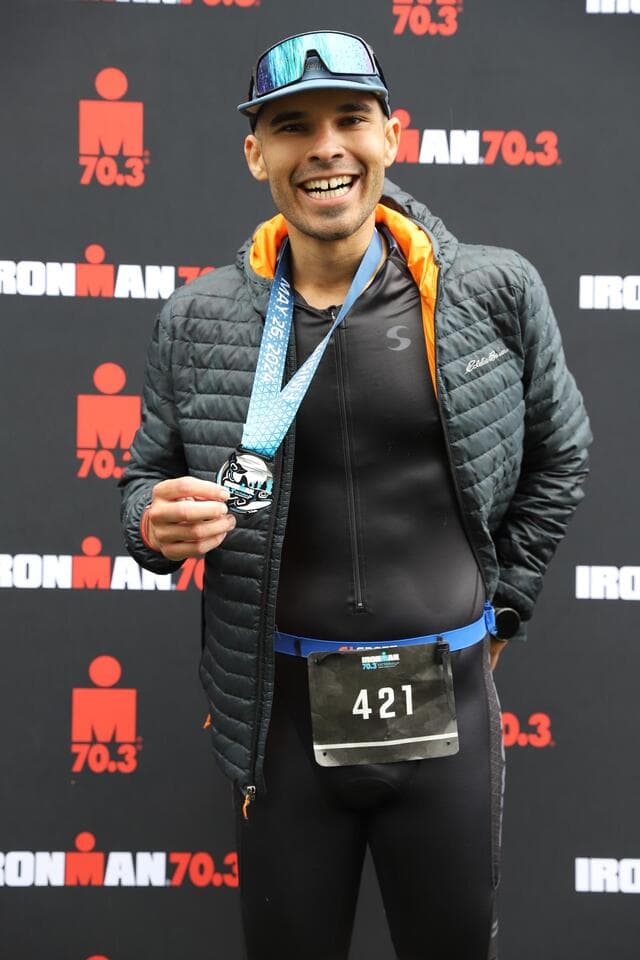
I finished my first Ironman 70.3. That's the main thing, and it matters more than any split.
But the learnings are real and I'm already thinking about how to act on them:
- Stop and fix the goggles. Five seconds in the water is worth it. Non-negotiable next time.
- Leave the deep-section wheels at home in uncertain conditions. A slower-but-controlled ride beats a fast-but-terrified one every single time. I should have been on standard clinchers.
- Build bike confidence before the next race. Aerobars, descending, riding in variable wind — all of it needs dedicated practice. Not fitness work. Bike handling.
- Practice T2. Getting race shoes on after a bike effort is a skill. Treat it like one and drill it.
- Water intake calibration. Three pees on the bike in cold conditions means I overdid it on fluids pre-race. I need to adjust that protocol.
- Pre-race logistics: leave later. 3:50am for a race with a rolling start was too early. Getting more sleep is worth more than extra standing time at transition.
The run taught me something useful too: the lactate work I did in training paid off exactly when it was supposed to. That sub-5:00/km opening pace on tired legs came from somewhere. That confidence I'm keeping.
Victoria 70.3 2024 was messy, cold, stressful, and in places genuinely uncomfortable. But crossing that finish line — after the foggy goggles, after the wind gust, after everything — was worth every anxious night the week before. The next one will be different. I can't wait.
Thinking about your own first 70.3?
See how your expected finish time compares to real historical fields, or browse courses by difficulty to find the right first race for you.
Browse race data