
Practice Your Race Nutrition: How to Train Your Gut in Every Workout
You would never toe the line of a 70.3 on legs you'd never tested at race pace. So why do so many of us show up with a gut we've never asked to work that hard? Fuelling is a skill, and like any skill it has to be rehearsed. Here's what I've been learning by deliberately practicing my nutrition in training — carbs, caffeine, and all the messy trial and error in between.
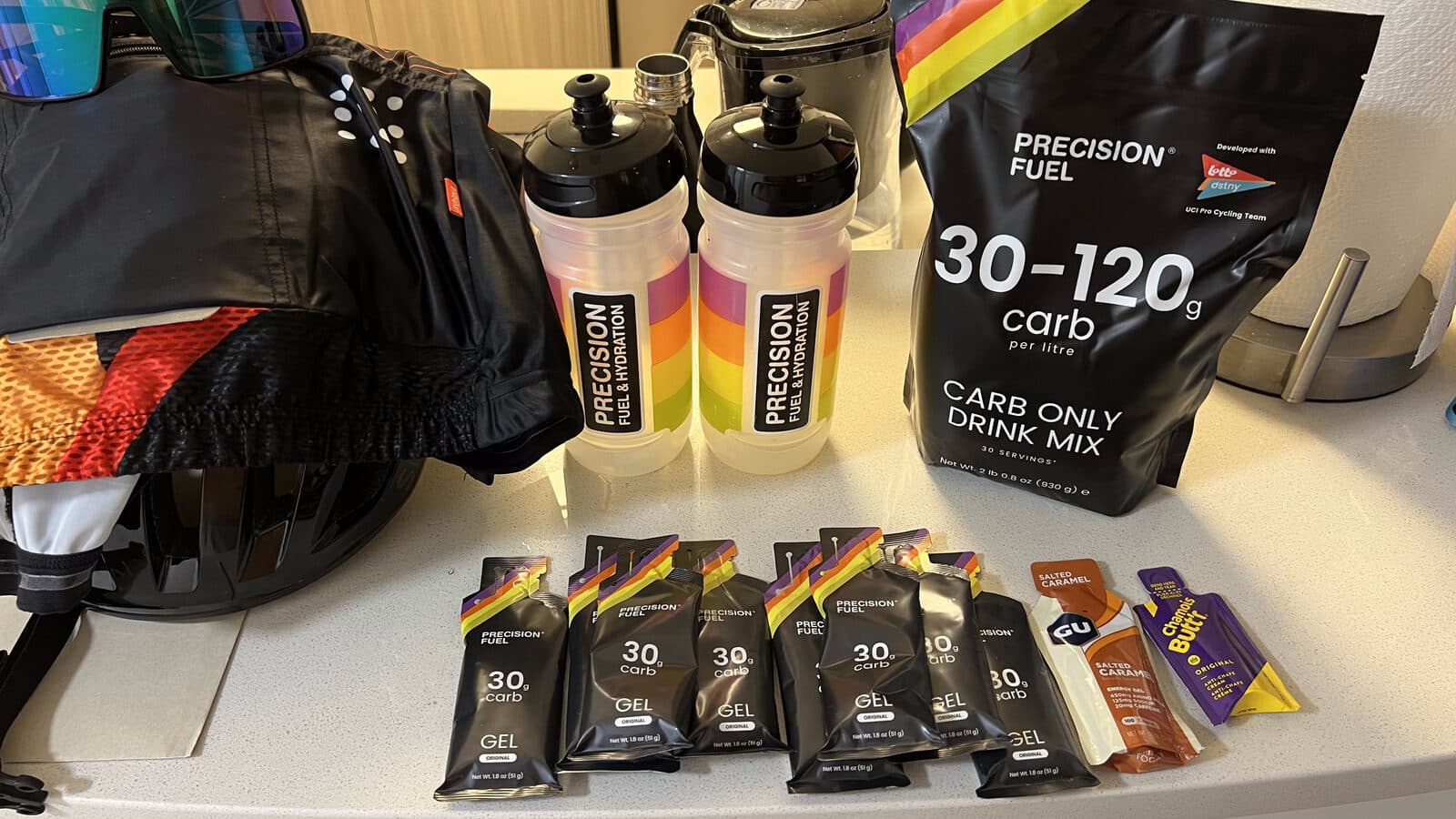
A bike day laid out: Precision's carb-only drink mix (30–120g per litre), a row of PF 30 gels, and the bottles that carry it all. None of this works on race day if you haven't rehearsed it first.
Your gut is a trainable organ
The single most freeing idea in endurance nutrition is that carbohydrate tolerance is not fixed — it's a trainable adaptation, just like your aerobic engine. Take an untrained stomach and it typically taps out around 60g of carbohydrate an hour before things go sideways. But the intestine responds to a repeated stimulus: deliberately fuelling at higher rates upregulates the transporters that pull sugar across the gut wall, expanding how much you can absorb and use. Research shows that even a couple of weeks of structured "gut training" measurably improves absorption and reduces the bloating, cramping, and nausea that wreck so many races. Most athletes can build to 90g/hour; some push to 120g/hour or beyond — but only if they've trained for it.
And it's worth it. In a study of elite trail runners over a mountain marathon, the group taking 120g of carbohydrate per hour showed less neuromuscular fatigue and recovered high-intensity running capacity better a full day later than the groups taking 60 or 90g. The catch, as Precision Fuel & Hydration and the wider sports-science world keep stressing, is that those numbers are earned over months of practice, not conjured on race morning.
This is a real shift from how the sport used to think. Not so long ago, the standard advice was something like 20–30g of carbohydrate every 45 minutes, and anything more was considered a recipe for GI distress. We are now firmly in what Triathlete has called the "era of peak carbs" — even marathoners have dramatically increased their in-race intake. So if you're still taking one gel and calling it fuelled, this is your nudge: you are almost certainly leaving free performance on the table. Start experimenting with more.
Why I avoid gels on the run — and why I'm fixing that
Here's my honest confession. For years I've fuelled the bike aggressively and then basically starved the run. By the time I'm off the bike, my stomach is already grumpy from an hour or more of concentrated gels, and the last thing it wants is another one. So I'd take almost nothing on the run to avoid a cramp or, worse, an unscheduled bathroom stop. The problem is that in a half marathon, running on empty has consequences — you can build the fitness of your life and still hand back minutes in the final 5km because you're out of fuel.
So this block, I've made run fuelling a deliberate project. Two data points from the last two weeks:
- Long run, week one — 1h45, 120g of carbs. Four Precision PF 30 gels over the run. It was the first time in my life I'd taken that much carbohydrate on foot, and I did it on purpose — training the gut so I can eventually run a triathlon off a properly fuelled bike without falling apart.
- Long run, week two — 1h45, 120g again, but split differently. This time two PF 30 caffeine gels and two regular PF 30s. My stomach was completely fine — and the two caffeine gels gave me a noticeable lift late in the run. That combination is very likely to be my race-day plan for Ironman 70.3 Washington Tri-Cities this September.
That caffeine lift isn't a placebo. The evidence base for caffeine is about as solid as it gets in sports nutrition: doses of roughly 3–6 mg per kg of body weight reliably improve endurance performance by 2–4%, and a well-timed top-up in the back half of a long effort can deliver that lift exactly when fatigue is biting. But — and I'll come back to this — caffeine is also the single easiest thing to get badly wrong if you don't rehearse it.
The gel flask: a small logistics hack that changes how much you eat
One reason both of those runs went smoothly is boringly practical. I use Precision's reusable gel flask, which holds four PF 30 gels — a clean 120g of carbohydrate — in a single soft flask. Two things happen when you do this. First, the logistics get trivial: I carry one item instead of four sticky pouches, and there's nothing to tear open mid-stride. Second, and less obvious, I actually eat more. A hard squeeze every few minutes takes zero mental effort, so I stop rationing my fuel and rationalising why now isn't a good moment to fumble with a wrapper. Remove the friction and you remove the excuse.
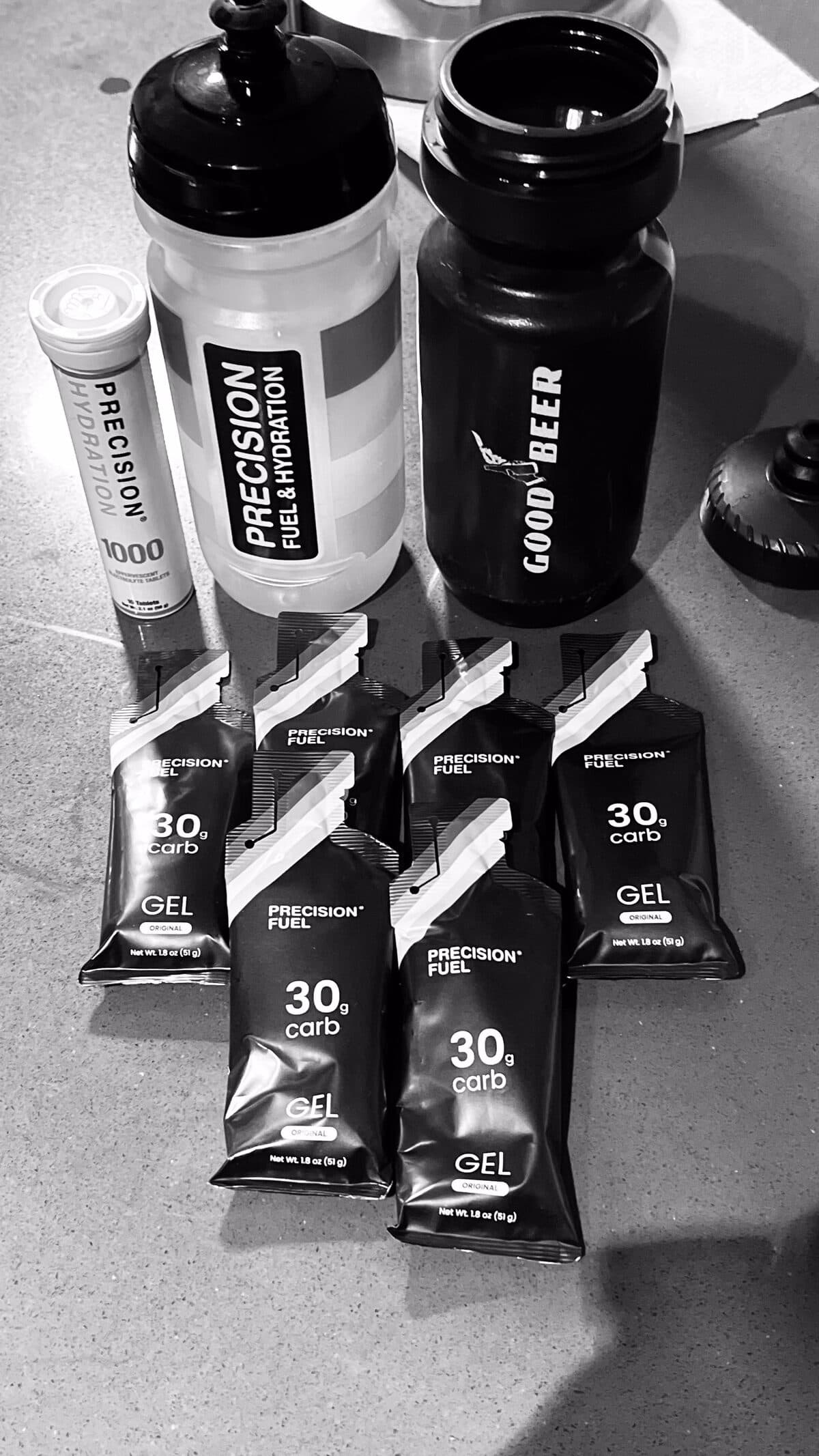
A long bike ride's fuel: PF 30 gels, a tube of Precision 1000 electrolytes, and the bottles to wash it all down. Dialing in the bike is what earns you the legs — and the stomach — for the run.
Every workout is a chance to rehearse
Your coach or training plan will hand you the occasional "race-practice" brick or long ride where you're told to run your full race fuel plan. Those are gold — but they are not the only sessions where fuelling can be practised. In fact, some of the most useful experiments happen in workouts that have nothing to do with race simulation:
- A threshold run is the perfect place to learn whether you can rip open a gel and swallow it while your heart rate is pinned and your breathing is ragged. That skill is completely different from sipping a gel on an easy jog.
- A VO2max bike session tells you how your gut handles 30g of carbs or a slug of concentrated electrolyte drink while you're deep in the red. If it's going to rebel at intensity, better to find out on your trainer than at kilometre 70 of a race.
The point is simple: don't save experimentation for your race-practice sessions, and never save it for race day. Every single week is a free rehearsal.
Fuel for the workout — and for the one after it
Here's a reframe that changed how I think about mid-session fuelling: the carbohydrate you take in a workout isn't only fuel for that workout. It's also fuel for the next one. The gel you take at the 2h45 mark of a three-hour Saturday ride isn't just keeping you moving to the end of the ride — it's topping off the glycogen you'll need for Sunday's 90-minute long run. Under-fuel the back end of today's session and you quietly sabotage tomorrow's. Once you see your fuelling as a rolling account across the whole training week, taking "one more gel" late in a session stops feeling optional.
Two expensive lessons I learned the hard way
Everything above sounds tidy in writing. In practice, I've learned most of it by getting it wrong. Two races taught me more than any amount of reading.
T100 last year: the caffeine crash I didn't see coming. I decided race week was a great time to try something new — the SiS Beta Fuel 40g gel on the bike, at around 120g/hour. What I didn't clock until months later was that this particular gel is loaded with caffeine (the nootropics version carries 200mg a serving). Stack that up over a bike leg and you're taking an enormous caffeine dose early, which set me up for a brutal crash on the run. You can read the full T100 Vancouver race report for how that unravelled. The lesson has stuck: read every label, count your total caffeine across the whole race, and — I cannot say this enough — don't leave your experimentation for race day.
Tri-Cities last year: great bike fuelling, timid run. The flip side. I used Precision's drink mix to take 90g of carbohydrate and 1,000mg of sodium per hour on the bike, and I felt fantastic coming off it. But because the day was going so well, I got conservative and only took about 30g/hour on the run — I didn't want to risk upsetting a stomach that was, for once, behaving. It worked out, but it left me wondering how much more I had in the tank. That question is exactly why I'm drilling 120g run fuelling now: this year I want to earn the right to be braver.
Experiment with a calculator, not a guess
If you want a sane starting point for how much to take — rather than reverse-engineering it from a bad race — my friends over at Even Splits Lab built a genuinely useful fuel calculator. Plug in your weight and the duration of your effort and it spits out a personalised hourly carbohydrate and sodium target you can then take into training and experiment with. Treat its number as a hypothesis to test in your long sessions, not a commandment.
They also just published a level-headed breakdown of lactate gels — the buzzy new fuel showing up at the Tour de France and in a sub-2-hour marathon debut. The short version: lactate isn't the fatigue "toxin" your old coach warned you about — your muscles, heart, and brain actually burn it for energy, and it's absorbed through a different set of gut transporters than glucose, so the pitch is that it lets you pack in even more total fuel. The honest catch, which the article lays out well, is that the performance evidence is still thin and mixed. For the rest of us, nailing a proven carbohydrate strategy is a far better use of attention than chasing a brand-new molecule. It's a good, skeptical read.
The takeaway
Race-day nutrition is not a plan you write down the night before. It's a skill you build, one session at a time — training your gut to absorb more, learning how your body responds to caffeine, sorting out the logistics so fuelling is effortless when you're hurting. Treat every long run and every hard interval as a rehearsal, keep notes on what works, and by the time you get to the start line, your fuel plan won't be a gamble. It'll be a routine you've run a hundred times.
Know the number you're fuelling for.
Your fuel plan only matters relative to the pace you're trying to hold. See the real splits and Top-5% finish times for your race with the estimator, and if a 70.3 Worlds slot is the goal, our full 70.3 fuelling guide walks through building your race-day numbers.
Try the race estimatorSources & Further Reading
- Precision Fuel & Hydration — How Much Carbohydrate Do Athletes Need Per Hour?
- EndureIQ — 90 vs 120g of Carbohydrate for Endurance Performance
- The Feed — 90g Carbs Per Hour and Training the Gut
- Triathlete — How Should Triathletes Handle the "Era of Peak Carbs"?
- PMC — Caffeine Supplementation Strategies Among Endurance Athletes
- Even Splits Lab — Fuel Strategy Calculator
- Even Splits Lab — Lactate Gels: What the Science Actually Says